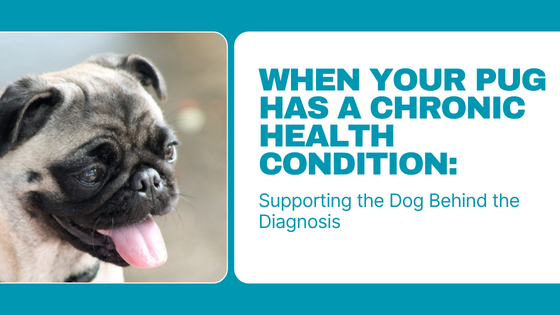
This guest post comes from Lisa McCabe of The Dog Witch, who shares her advice on supporting pugs with chronic health conditions.
Finding out that your pug has a chronic health condition can change the way you look at almost everything.
A diagnosis may finally provide an explanation for symptoms that have been worrying you for months but it can also leave you wondering what life will look like from now on.
Whether your pug has respiratory disease, allergies, arthritis, digestive problems, skin disease or another long-term condition, their diagnosis is only one part of the picture.
Your pug is still a dog with their own personality, preferences, needs and ways of communicating with you.
Supporting a dog with chronic health problems is not simply about managing the condition itself, it is about looking at the whole dog and considering what you can do to make everyday life as comfortable, enjoyable and manageable as possible.
Look beyond the diagnosis
A diagnosis gives you important information, but it does not tell you everything about your dog.
Two pugs can have the same condition and experience it very differently.
One may continue to enjoy walks and playing with toys, while another may tire quickly or become reluctant to move.
One may cope well with changes in their routine, while another becomes unsettled or anxious.
This is where paying attention to your individual dog becomes so important.
Think about what is normal for your pug and notice changes in their behaviour, appetite, sleep, movement, interaction with you and interest in the things they usually enjoy.
Dogs are remarkably good at adapting, which can sometimes make gradual changes surprisingly difficult to spot.
Your observations are valuable information to share with your veterinary team, particularly if something changes or you are concerned that your dog is struggling.
Consider their environment
The environment your pug lives in can have a surprisingly significant influence on how comfortable they feel.
For a dog with mobility problems, slippery floors, awkward steps or jumping on and off furniture may create unnecessary physical challenges.
For a dog with respiratory problems, heat and poor ventilation may be particularly important considerations.
A dog with skin problems may benefit from looking carefully at potential environmental triggers.
You do not need to completely redesign your home overnight, instead, look at your pug’s day from their perspective.
Can they get comfortably to their bed, food and water? Do they have somewhere quiet to rest? Is their sleeping area supportive and comfortable? Are there places where they regularly struggle to get around?
Small environmental adjustments can sometimes make everyday activities easier and reduce unnecessary physical or mental strain.
Protect the importance of sleep
Sleep is easy to overlook when you are concentrating on a medical condition, but good-quality rest is fundamental to wellbeing.
A dog who is uncomfortable, itchy, struggling to breathe, experiencing digestive upset or dealing with pain may find it difficult to settle properly.
Interrupted sleep can then affect how they cope with the rest of their day.
Your pug may also need more rest than they did before their diagnosis.
That does not necessarily mean they are becoming lazy or that you need to keep them wrapped in cotton wool, it means recognising that their body may be working harder than it once did.
Give them opportunities to rest without constantly disturbing them and pay attention to whether their sleeping habits have changed.
If your pug suddenly becomes much more tired or their sleep is significantly disrupted, that is something worth discussing with your vet.
Adapt exercise rather than abandoning it
Exercise is another area where chronic illness can create confusion.
It can be tempting to think that if your pug has a health condition, exercise should be avoided altogether.
In reality, the right amount and type of activity will depend on the individual dog and their veterinary advice.
For some dogs, shorter and more frequent walks may be easier than one long outing, others may benefit from gentle enrichment activities at home when a traditional walk is not appropriate.
The important thing is to think about quality rather than quantity.
Your pug does not need to complete a certain number of miles to have had a worthwhile day.
Sniffing, exploring, playing appropriately, learning something new and spending time with you are all valuable forms of enrichment.
Let your dog’s condition and individual tolerance guide you, rather than comparing them with another pug who happens to have more stamina.
Nutrition is part of the bigger picture
Nutrition can become a particularly complicated subject when your dog has a chronic health condition.
There is no universal diet that is right for every dog and nutritional requirements can change depending on a dog’s health, medication, age, activity levels and individual circumstances.
If your pug has a diagnosed condition, discuss their nutritional needs with your veterinary team before making significant dietary changes.
Beyond the contents of the bowl, however, there are other things worth considering.
Is your pug eating comfortably? Has their appetite changed? Are they drinking more or less than usual? Are they maintaining an appropriate body condition? Are treats and extras contributing more calories than you realise?
For a pug, maintaining a healthy body condition is particularly important because carrying excess weight can place additional demands on the body.
Nutrition should therefore be viewed as one part of supporting your dog’s overall wellbeing rather than a quick fix for a chronic condition.
Don’t forget their emotional wellbeing
Chronic health problems can affect how a dog feels about the world around them.
A dog who is frequently uncomfortable may become less tolerant, more withdrawn or more easily overwhelmed.
A dog who cannot participate in activities they previously enjoyed may become frustrated.
Changes to routines, exercise or social interaction can also affect them.
This does not mean every change in behaviour is an emotional problem, behaviour is communication and a change in behaviour can sometimes be one of the ways a dog tells us that something physical is wrong.
Instead of simply trying to stop an unwanted behaviour, consider what might be contributing to it.
Has something changed? Is your pug tired? Are they uncomfortable? Are they being asked to cope with more than they currently can?
Looking at the whole picture can give you much more useful information than focusing on the behaviour in isolation.
Keep life enjoyable
Perhaps the most important thing is not to allow the diagnosis to become your pug’s entire identity.
They may have a chronic condition, but they are still the dog who loves a particular toy, follows you around the kitchen, enjoys a good sniff or insists on sleeping in exactly the wrong place.
Their life may need to look different but different does not have to mean diminished.
Find the things they can still enjoy and make those things part of everyday life, adapt activities when necessary, celebrate the good days and on harder days, lower your expectations rather than assuming you have failed.
There will inevitably be uncertainty when you share your life with a dog who has a chronic health condition.
You may have good days, difficult days and days when you question whether you are doing enough.
You do not have to manage every aspect perfectly.
Supporting a dog with a long-term health condition is about understanding the individual behind the diagnosis and considering all the factors that contribute to their quality of life: sleep, exercise, environment, health and wellbeing, nutrition and behaviour.
The medical diagnosis matters enormously but so does the life your pug gets to live alongside it.
Remember the most valuable thing you can give them is not another treatment or product, it is the time, attention and understanding to notice what they are telling you and make their world work a little better for them.
If you would like more tailored support to your dog’s individual needs, please check out my work at https://www.thedogwitch.co.uk